AI Verification is needed for the US & China to pace AI development
What tools are available to ensure everyone sticks to the rules on pacing frontier AI development?


On the 28th of July 2026, leading figures from all the major AI developers requested that the U.S. government support work to develop tools that help humanity deliberately pace the frontier of automated AI development.
Technical tools that enable international coordination over AI development are often called “AI verification technologies”. Verification technologies can let the US and China both pace automated AI development, without having to naively trust one another.
Verification technologies enabled extraordinary international coordination on nuclear development, and this was underpinned by trust-building verification technologies. As Reagan famously put it: “Trust, but verify”.
We believe that the verification of AI development rules is possible
The verification field kicked off a month before the release of GPT-3, with researchers from industry (OpenAI, Google Research), academia (Stanford, Oxford, Cambridge), and think tanks writing a seminal paper calling for long-standing computer security, hardware and cryptography expertise to be applied to making AI development verifiable.
Since then, technical verification plans have been progressing, and there now exists a whole field of research developing the primitives for and pilots of AI verification systems.
The goal is simple: to have the optionality to make claims about AI development and deployment provable, rather than trusting assertions and documentation. This could be applied to pacing the frontier of automated AI development, with some example claims being:
This compute is only being used for inference and not training.
The model being served on this compute (e.g. for internal AI R&D) is a specific model that has passed certain evals.
Training is proceeding according to some agreed training code and data.
This list is not canonical. We are building tooling to support verification, but need guidance from companies and governments on which claims are highest priority - because while some verification tools are general purpose (they allow us to verify a few different rules), some are narrowly tied to a single claim.
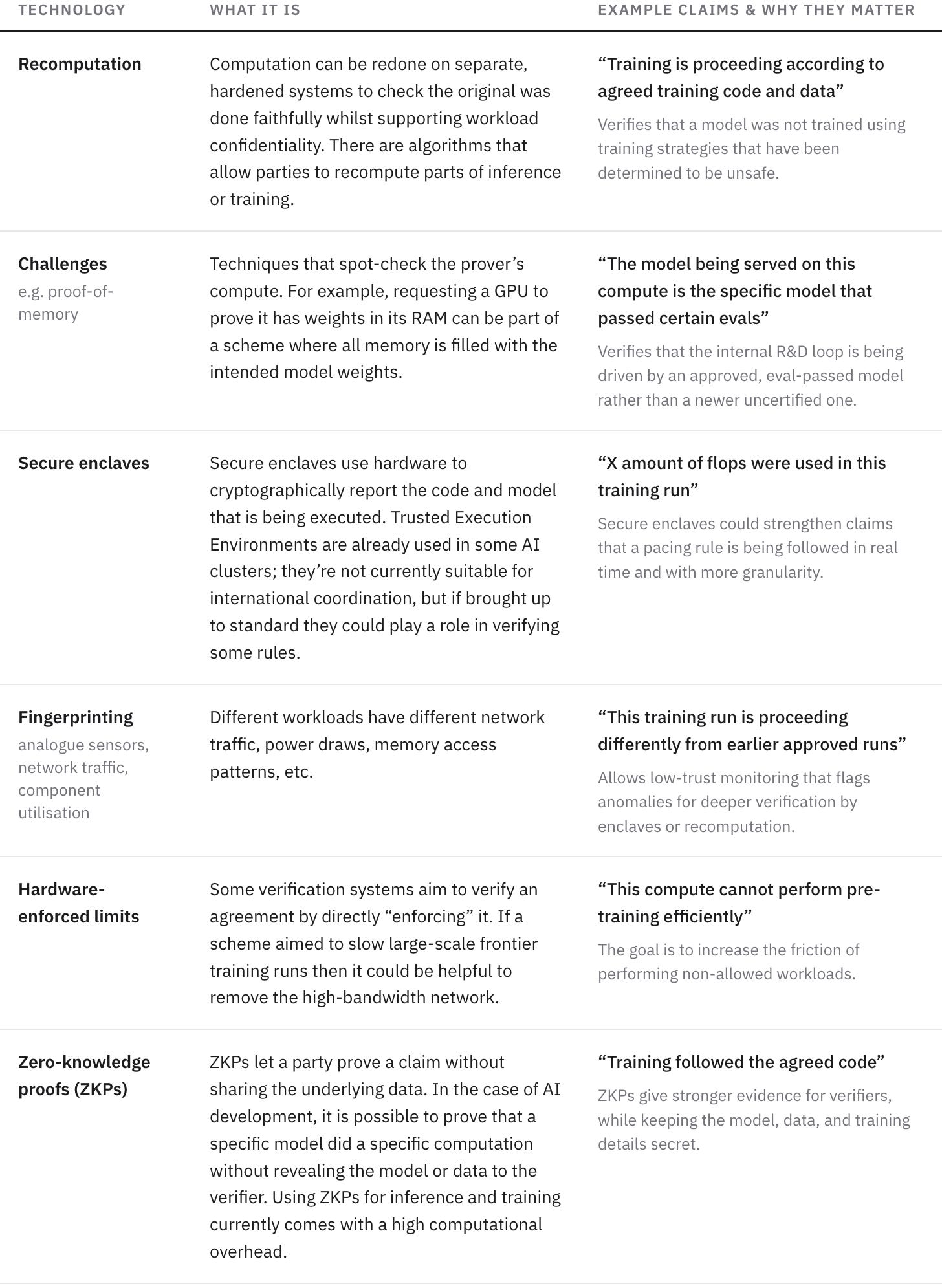
Different schemes require different primitives from the list above. On top of this, there are supporting technologies that are needed to enable different schemes; for example, some need network TAPs, proof-of-secure-erasure, power monitors, and improved security based on deployment context. All of these schemes should be underpinned by structured transparency: the parties define a narrow set of claims that can be externally checked while withholding model weights, training and customer data, evaluation sets, and unrelated infrastructure details.
The technical toolkit will not exist in isolation. Verification schemes should be layered, leaning on the established combination of intelligence, whistleblowers, audits, and more.
Work is underway
Verification technologies will be developed incrementally, and we’re climbing a ladder both on the robustness and precision axes.

Research teams are working on both technical primitives and pilot system demos. Here is what we’re working on at Amodo and Lucid Computing.
Amodo
Amodo is a hardware engineering firm creating a pilot recomputation system. (Network TAPs and DiFR on a rack of NVIDIA H200s).
In addition to this pilot, they have workstreams working on core technical pieces: packet-hashing, power analysis, network TAP design, memory-wipes, and more.
Lucid Computing
Lucid is a startup whose research arm advances verification mechanisms through experimentation, validation, real-world deployment, and open standards, building optionality for verifiable coordination before the moment it is needed.
They are currently operating an adversarial testbed for verification mechanisms, instrumenting racks with H100 servers inside a research cluster with a government-funded red team that holds technical authority over the test plan and publishes results, negative findings included.

A field worth pursuing
Verification R&D is already underway; creating the high-level verification schemes and foundational primitives that we need to deliberately pace the frontier of automated AI development. We would be excited to see many more teams build their own reference architectures against specific claims, with the goal being ”radical optionality” rather than just having one plan.
We’ve done this before. Nuclear verification technologies were the result of the hard work of scientists, engineers, diplomats, and funders – all working together on a mission that would have felt insurmountable. Drawing inspiration from the ARPA programmes (Project Vela) and international cooperation (Joint Verification Experiment), we must apply this same ambition to AI verification.